Gonzales, Louisiana Foster Care Abuse Case: Ascension Parish Couple Arrested After Years of Alleged Abuse
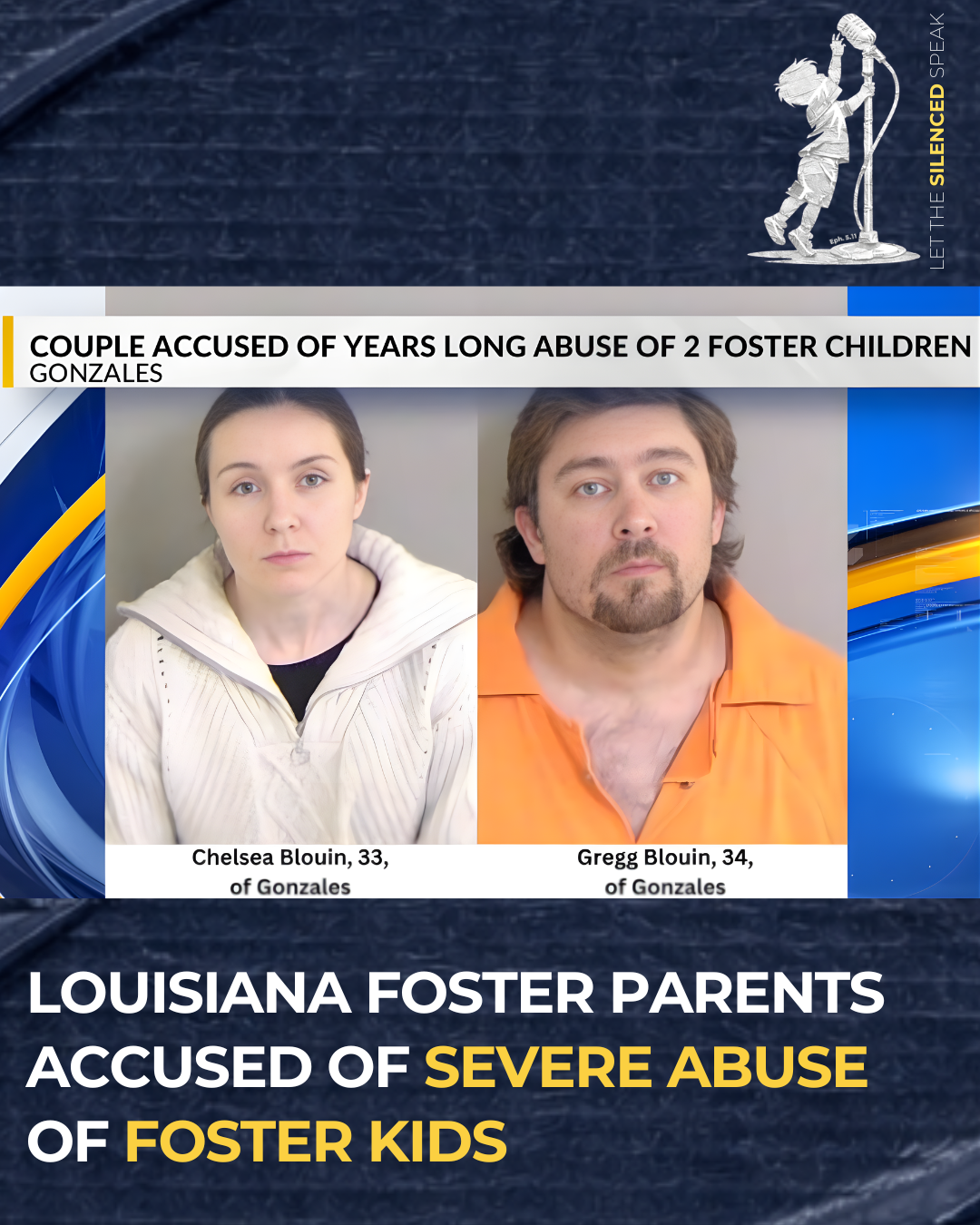
GONZALES, ASCENSION PARISH, LOUISIANA — Two adults in Gonzales are facing felony charges after authorities say they abused two young children in their custody for years.
33-year-old Chelsea Blouin and 34-year-old Gregg Blouin were arrested after detectives began investigating allegations of child abuse earlier this month.
When deputies responded to the home on Sycamore Bend Avenue in Gonzales, they found two children — ages 5 and 7 — with severe bruising and visible injuries, according to the Ascension Parish Sheriff’s Office.
Authorities say the children had been in the Blouins’ custody for approximately three and a half years.
Both defendants have been charged with second-degree cruelty to juveniles. Chelsea Blouin also faces additional charges, including resisting an officer and obstruction of justice.
The children were removed from the home.
What Is Second-Degree Cruelty to Juveniles in Louisiana?
Under Louisiana law, second-degree cruelty to juveniles generally involves the intentional or criminally negligent mistreatment of a child that results in serious bodily injury or neurological impairment.
These are not minor allegations.
These charges reflect claims of prolonged and extreme punishment — not isolated incidents.
Foster Care and Safety: The Larger Context
This case does not stand alone.
It fits into a broader national pattern that researchers, federal auditors, and child welfare reform advocates have been documenting for years.
1. Most Children Are Removed for “Neglect”
According to the U.S. Department of Health and Human Services (HHS) Child Maltreatment Reports:
Approximately 60–75% of child removals nationwide are categorized as neglect.
Neglect is broadly defined and often includes poverty-related conditions such as inadequate housing, lack of supervision, or unmet medical needs.
In many cases, removal is not based on sexual abuse or torture-level violence. It is based on a legal category that leaves room for subjective interpretation.
Yet when removal occurs, the state assumes full responsibility for the child’s safety.
2. Foster Care Does Not Automatically Equal Safety
Multiple analyses of state and federal data indicate that children in foster care face elevated risks compared to children in the general population.
Research has suggested:
Children in foster care may be 2 to 10 times more likely to experience sexual abuse compared to children not in state custody (range reflects variation across studies and jurisdictions).
Placement instability correlates with higher rates of behavioral problems, trauma symptoms, and long-term mental health challenges.
Children with prior CPS involvement are disproportionately represented in child fatality statistics.
While many foster parents provide safe and loving homes, oversight consistency varies significantly by state and county.
3. Oversight Gaps and Monitoring Concerns
The Gonzales case raises difficult but necessary questions:
Were routine home visits conducted consistently?
Were the children interviewed privately?
Were warning signs documented or dismissed?
Did system overload or staffing shortages play a role?
These questions are not accusations — they are accountability measures.
Child welfare agencies operate under immense strain nationwide, including high turnover rates and heavy caseloads. However, systemic strain does not reduce the obligation to protect children once they are removed from their families.
The Trauma of Removal
Family separation is itself a high-impact intervention.
Research published in Pediatrics and other peer-reviewed journals has shown:
Children in foster care experience higher rates of anxiety and depression.
Placement instability can worsen behavioral outcomes.
Disruption of primary caregiver attachment can have lasting developmental consequences.
When removal is based on broadly defined neglect or poverty conditions — and the foster placement then becomes unsafe — the trauma compounds.
Ascension Parish and Louisiana: What Happens Next?
The Blouins now face criminal proceedings in Ascension Parish.
For the community, however, the case raises larger issues:
How are foster homes screened?
How frequently are children interviewed alone?
What transparency mechanisms exist?
How does Louisiana track and audit foster home complaints?
Public trust depends on clear answers.
A System Under Scrutiny
The Gonzales foster care abuse case highlights a reality that is difficult to confront:
Removal from a biological home does not guarantee protection.
State custody is not inherently safer.
Oversight is only as strong as its enforcement.
When children are taken into foster care, the promise is safety. When that promise fails, the consequences are irreversible.
Ascension Parish residents deserve transparency.
Louisiana families deserve accountability.
And children — whether in biological homes or foster placements — deserve protection that does not depend on assumption.
Sources
Ascension Parish Sheriff’s Office reporting via WDSU News.
U.S. Department of Health & Human Services, Child Maltreatment Reports.
Administration for Children and Families (AFCARS Data).
GAO Reports on Foster Care Oversight.
Peer-reviewed studies on foster care outcomes (Pediatrics, Child Abuse & Neglect).