Jennifer Thompson McComas, Bryan County DFCS, and the Georgia Child Welfare Case Raising Serious Questions About Reunification, Drug Testing, and Due Process
Update: Father’s Advocacy Network reached out to DFCS on March 10, 2026 requesting comment on the issues discussed in this report. As of this time, no response has been provided. Also, since publishing this report, Father’s Advocacy Network has been contacted by several additional parents in Bryan County who have raised concerns about how their child welfare cases were handled. We are currently collecting documents, case reports, and other evidence and will share additional stories once our review of each case is complete. Have a case that you believe was improperly handled by Bryan County? Reach out to us today.
Bryan County, Georgia — In child welfare cases, the state has extraordinary power. It can remove a child, shape the evidence presented to a judge, limit the pace of reunification, and decide whether a parent’s compliance matters—or whether the case will simply continue.
That is why the attorney representing the state matters.
In the Georgia DFCS case that began in Clayton County Juvenile Court and later moved into Bryan County, one of the central legal actors has been Jennifer Thompson McComas, a Special Assistant Attorney General (SAAG) representing the Department of Family and Children Services.
An independent complaint and investigative report submitted to the Georgia Office of the Child Advocate alleges that this case has been marked by a series of systemic failures: a child removed despite an identified and available father, a “no family available” narrative presented after DFCS had already obtained paternal information, repeated reliance on disputed drug screens, a lack of documented safety threats against the father, stalled reunification, withheld or incomplete records, and a litigation posture that, according to the report, preserved separation rather than correcting error. The report states that the investigator has 17 years of law-enforcement and child-welfare experience and reviewed the case through policy, law, and documentary evidence.
The public-interest question is no longer simply whether the caseworkers made mistakes.
It is whether the legal process—under the watch of the attorney representing DFCS—helped keep those mistakes in place.
The case began with a birth, an incarcerated mother, and an available father
According to the report, the child was born in December 2023 while the mother was incarcerated. Before the birth, the report says the mother and the father had been in a relationship, that the father was identified as the biological parent, and that the mother had executed a durable power of attorney naming the father as her decision-maker if she became incapacitated by mental illness. The report further says that this documentation, along with father/family contact information, had been provided to prison officials and to the mother’s physician.
The report states the father was not contacted when the child was born. Instead, he says he learned of the birth only after a state medical card arrived in the mail at his address around December 28, 2023, after which he went to the hospital and began contacting DFCS himself.
That timeline matters because the report says DFCS workers went to the prison on January 5, 2024 and obtained information regarding the father and other family. Yet on January 10, 2024, a dependency removal order was filed in Clayton County Juvenile Court, and the report alleges that the filing stated there were no family members available to care for the child. A dependency petition followed on January 22, 2024 under Case No. 057912-00-01.
If that sequence is accurate, it creates one of the most serious questions in the case:
Why did the state present a no-family narrative after obtaining father and family information days earlier?
The OCA complaint says the father was systematically denied the chance to parent
The initial summary of findings in the report is not subtle. It states that the investigation found “significant evidence” that the father was systematically denied an opportunity to be a father, that DFCS did not make reasonable efforts to engage him or develop a reunification-focused case plan for him, and that there were no identified danger threats or concerns explaining why the child could not return home to him. The report adds that the father remained on supervised visitation despite doing what DFCS required of him.
The same summary says there was never a safety assessment conducted on the father, that no present or impending danger threats were identified as to him, and that the only safety issue reflected in the dependency petitions related to the mother’s incarceration and mental health—not the father. It further states that he had no criminal record, had raised several children as a primary caregiver, had housing that met DFCS standards, and had been visiting the child regularly without incident.
That point is foundational.
Because if there was no documented safety danger specific to the father, the case should have been moving toward reunification—not drifting through county transfers, disputed testing, and prolonged supervision.
Concerns about venue and jurisdiction
The complaint states the case remained in Bryan County even though, according to the investigator, the father did not reside there, the mother was incarcerated in another county, and the child was not placed in Bryan County. The report says DFCS was aware of this conflict issue and jurisdictional concerns.
That matters because venue is not just a paperwork issue in dependency court. Venue determines which court, which local bureaucracy, which clerk’s office, and which local actors end up shaping the process. If the venue itself is in dispute, the legitimacy of everything that follows becomes harder to defend.
The early court record raises more questions, not fewer
The report says Clayton County DFCS represented in its dependency petition and Bryan County DFCS at case transfer, the child could not be placed with the father because he had not yet been assessed—even though the petition allegedly did not identify any safety concerns, danger threats, or diminished protective capacities specific to him. The report also says a DFCS case manager signed an affidavit attesting that the information in the petition was true and correct.
This matters because the United States Constitution and the United States Supreme Court has held that, “fit parents are presumed to act in their child’s best interest”. This is there to limit state interference in family life, but this is far too often not the case. Having no identifiable concerns for the father, DFCS and the court would have to assume he is a fit parent and would make decisions in his daughter’s best interest.
From there, the case moved through a series of hearings and orders that the investigator says repeatedly failed to resolve the central issue: why the child was still not being returned to the father.
The report says:
DFCS did not timely file a case plan for a May 29, 2024 disposition hearing and requested a continuance.
On June 8, 2024, the court found the child had been in Clayton County without a parent or legal guardian at the time dependency was deemed, and found DFCS had made reasonable efforts to reunify by placing the child in foster care, but the cited return-to-custody language referred to the mother, not the father.
A home assessment was completed on the father’s residence, and the report says DFCS raised renovation issues without identifying concrete safety threats. The report then states the father obtained a new residence and DFCS found no safety concerns there either.
The July 19, 2024 adjudication order, according to the report, reflected no safety concerns regarding the father, yet the investigator says DFCS still failed to update the legal narrative in a way that could have allowed the child to return home.
The report bluntly suggests that some of the legal documents appear to have been built from template language, rather than facts tailored to the case.
That allegation is serious, because child welfare judges often rely heavily on the accuracy of agency-drafted documents. If the documents are generic, stale, or misleading, the judge’s understanding of the case can be distorted from the start.
Paternity was later confirmed, but the case still did not turn
The report says the father was confirmed by DNA on October 15, 2024 with a 99.99% probability of paternity, and that he filed a petition to legitimate the child shortly afterward.
The same section states that during a November 14, 2024 hearing, a urine drug screening came back negative for all substances except norfentanyl, and that the court order itself noted the case supervisor could not confirm whether the screener had been informed of the father’s medications at the time of testing. The court ordered a hair-follicle screen to confirm or disaffirm the result.
That medication issue becomes crucial later.
Because throughout the report, the investigator returns to the same contention: prescription medication was being treated as evidence of illicit drug abuse, even when better testing, more precise testing, or basic medication review could have clarified the difference.
The drug-testing record is one of the most damning parts of the report
The report lays out a long sequence of drug screens and says the father repeatedly produced negative results.
The report states:
Independent urine drug screens on November 22, 2024 and November 26, 2024 were negative for all substances.
A February 4, 2025 substance abuse assessment concluded he did not meet the criteria for alcohol use disorder, and also recorded negative test results and the dismissal of the OWI allegation DFCS had used to suggest a substance problem.
An independent drug screen on March 13, 2025 was negative.
A state-run hair follicle test on May 6, 2025 through State Drug Testing & Occupational Health / Omega Laboratories was negative for all substances.
A subsequent hair-follicle test on June 22, 2025 through Medic Exams / Labcorp allegedly carried the wrong Social Security number, was labeled a duplicate report, and produced a positive methamphetamine screening at 100 pg/mg with a reported value of 429 pg/mg, even though the report allegedly showed no amphetamine level.
On June 25, 2025, the father completed another urine screen at Cordant Health Solutions and, according to the report, the hair screen was negative for all substances.
Through October, November, and December 2025, the father completed additional random urine screens through DFCS subcontractors, which he says were negative, but the report states case managers refused to provide him or his attorney copies of those results.
On December 19, 2025, he received a copy of results showing positive for “amphetamines” despite the report itself showing “ND” for amphetamine, with methamphetamine at 102 ng/mL and a cutoff of 100 ng/mL.
That timeline alone would merit scrutiny in any dependency case.
But the report goes further.
The report says the testing being used could not reliably distinguish prescriptions from street drugs
The investigative report argues that the case was being driven by tests that could not adequately distinguish between prescribed medications and illicit drug use.
Specifically, it states that:
A methamphetamine-positive result without corresponding amphetamine levels would, according to cited literature, suggest possible environmental exposure, prescription medication, or over-the-counter medication, not straightforward illicit ingestion.
Had Labcorp followed the cited FDA / CLIA / Federal Register cutoff values, the June 22, 2025 result would have been negative; the report says federal guidelines require 500 pg/mg for screening and 250 pg/mg for confirmatory methamphetamine testing, while DFCS subcontractors were allegedly using 100 ng/mL or 200 ng/mL cutoffs.
Labcorp offers D/L isomer testing, which can distinguish illicit substances from prescription and over-the-counter medication, but the report says DFCS refused to use it.
At no point were the labs said to have contacted the father to discuss his prescriptions or over-the-counter medications, even though those could explain false positives.
Those are not trivial allegations. They go directly to whether the state was using a blunt screening instrument where a precise differentiating test was available—and whether it continued to treat unconfirmed positives as if they were proof of criminal-style drug use.
The report also says the father went so far as to discontinue necessary medications tied to his disability to show that the screens were being driven by prescriptions. According to the complaint, when he stopped the medications, his screens were negative; yet the department still described him as a “drug addict” and someone suffering from a “drug dependency disorder.”
If that allegation is accurate, it is devastating.
Because it would mean reunification was being blocked by a theory the father was actively disproving with both documentation and testing.
The report says DFCS knew about the hair-testing scandal and kept using the same ecosystem anyway
The complaint devotes extensive space to Georgia DFCS’s continued use of hair-follicle testing despite prior public controversy, federal investigations, and false-claims settlements involving labs in the drug-testing industry.
It states:
Georgia DFCS currently contracts with Medic Exams, which does not perform testing directly but subcontracts with labs nationwide.
The report alleges strong evidence that some of the same labs Georgia DFCS had supposedly distanced itself from were still effectively part of the testing chain through subcontracting.
The report references public controversies involving Averhealth, Labcorp, and Cordant Health Solutions, and states DFCS knew of broader reliability concerns regarding hair testing before this case even opened.
The report cites statements that Averhealth admitted only 97% accuracy and did not perform confirmatory testing for courts, and alleges that even the labs’ own materials acknowledge limitations.
The report also cites Labcorp materials acknowledging that even positive hair tests are not necessarily conclusive and that additional confirmations, including isomer separation, may be needed.
That matters because the entire posture of this case appears to have treated screening-level results as determinative, while the very materials surrounding those tests were allegedly full of caveats and options for better confirmation.
The OCA complaint says there were never danger threats specific to the father
The report returns repeatedly to the same central conclusion: there has never been any documented present or impending danger threat specific to the father. It says no safety plan was required because no such threats existed, and that the concerns reflected on permanency documents were for the mother alone. It explicitly argues that, without such danger threats, the child does not need to remain in out-of-home placement as to the father.
That is the part of this case that makes everything else harder to explain.
If the father was not the safety threat, why did DFCS and its attorney keep litigating as if he were?
The report says reunification efforts were effectively nonexistent
On this point, the complaint is direct. It says DFCS made no reasonable efforts to reunify the child with the father and asks why, after 26 months, there had been no meaningful progress. It specifically questions why visitation had not progressed from supervised to unsupervised, why visits had not moved to the father’s residence, and why there was no documentation explaining the lack of progress.
The report also says the case plans were structured in a way that centered the incarcerated mother:
one case plan listed nine tasks for the mother, despite her inability to complete them while incarcerated
the father had two tasks, completed them, and still saw no progress
the plan remained effectively unchanged, and by August 28, 2025 another case plan was submitted that was almost verbatim to the earlier one, despite an anticipated reunification date of October 30, 2025 that came and went with the case still unresolved
The July 3, 2025 case plan section is especially telling. The report says the plan still identified the mother’s estranged husband as the child’s legal father despite prior legal adjudication and the father’s name being on the birth certificate. It also says the plan listed the father’s only assessed strength as “he loves his daughter,” while failing to recognize his repeated visitation, financial support, housing, and care efforts. The same case plan reportedly said he needed to “learn to manage his substance abuse” despite, according to the report, no evidence outside unconfirmed screens and testing methods the investigator describes as medically weak and racially biased.
That is more than poor drafting. It suggests a case plan that was either badly outdated, disconnected from the actual record, or intentionally resistant to recognizing the father’s progress.
Then came February 19, 2025 and the recording controversy
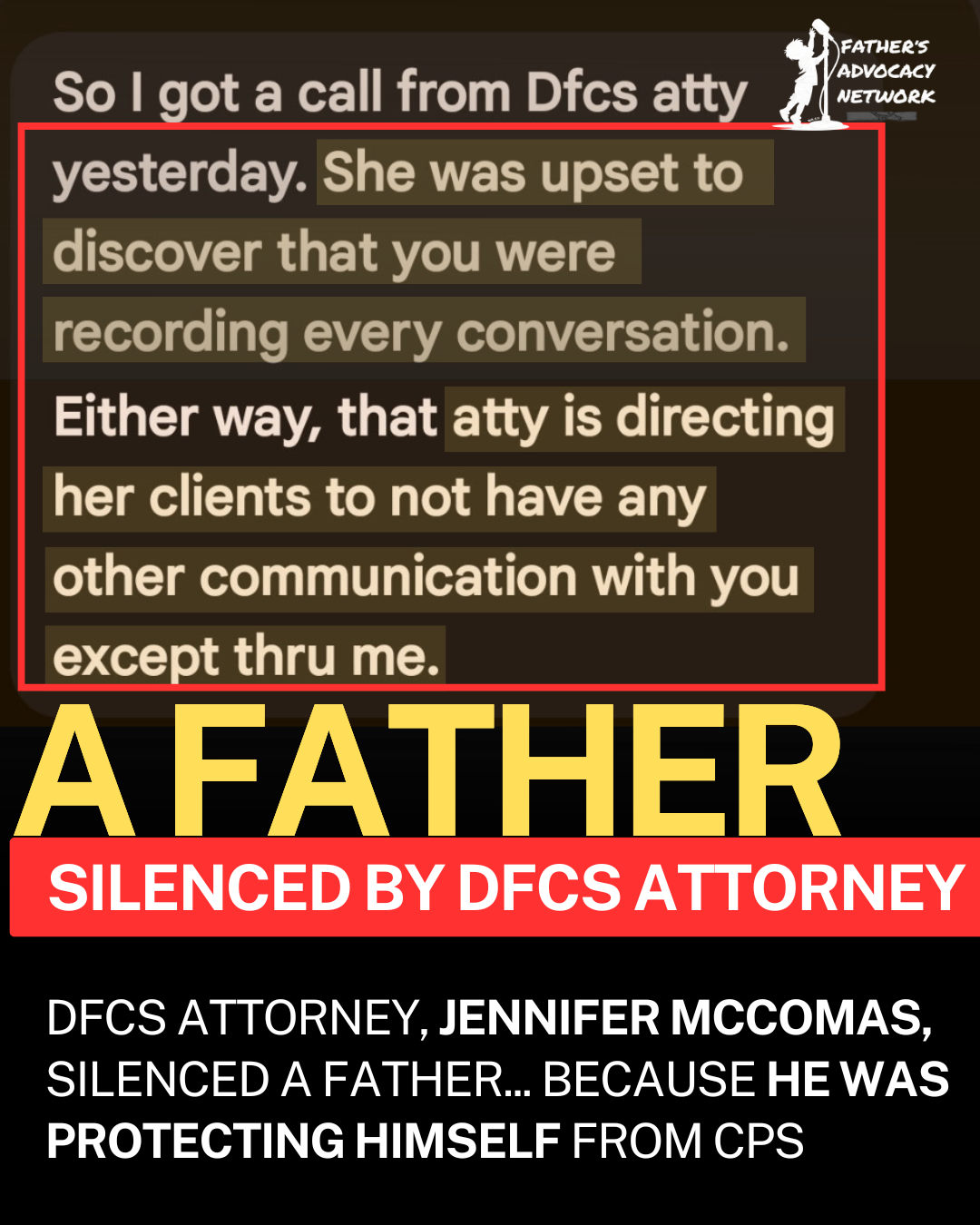
One of the most important Jennifer McComas-specific allegations is what happened after DFCS discovered the father had been recording calls.
According to the narrative accompanying the investigation, on February 19, 2025, Jennifer Thompson McComas called the father’s attorney because she was “extremely upset” to learn that he had been recording phone calls with DFCS workers. The same narrative states that the father had openly made it known from the beginning that he records calls and that Georgia’s one-party consent law permits that practice.
The allegation goes further: that Jennifer Thompson McComas then instructed the father’s attorney that he was not to contact any DFCS worker directly, and instead must communicate through counsel, who would communicate with the SAAG.
The significance of that allegation is not merely emotional.
If true, it means that once a record of DFCS communications existed, the father was effectively cut off from direct contact with the workers controlling his case.
That matters because dependency cases depend heavily on routine, ongoing communication about:
case-plan compliance
visitation
reunification progression
service coordination
family team meetings
day-to-day case decisions
If direct contact is blocked while the case continues to be measured against compliance and progress, the parent is no longer standing on equal ground.
Discovery, notice, and the ability to appeal are also part of the Jennifer Thompson McComas story
The narrative accompanying the investigation alleges that Jennifer Thompason McComas:
failed to file a motion to modify custody within 30 days as required by the Clayton County transfer order
failed to provide the father or his attorney necessary discovery information
failed to provide notices of “reduction of services”
failed to give proper notice when visitation time and case-manager contact were reduced, thereby depriving the father of a meaningful right to appeal because no official record existed to challenge
These allegations fit with themes already reflected in the OCA complaint, which repeatedly says records and test results were not being provided, and that the father and his attorney lacked documentation explaining the absence of progress. The report specifically says DFCS case managers refused to provide copies of negative urine-test results from multiple 2025 screens.
In any child welfare case, but especially one that has dragged on this long, notice and record are everything. If service reductions occur without formal documentation, the result is obvious: the parent loses not only time with the child, but the procedural ability to fight back.
The complaint raises a direct Bryan County conflict problem involving Sheriff Mark Crowe
The complaint itself opens by raising a direct conflict of interest concern involving Bryan County Clerk of Court Rebecca Crowe. Jennifer McComas and DFCS disclosed plans to have Sheriff Mark Crowe, Sheriff of Bryan County, testify against the father regarding alleged prescription opioid abuse—even though, according to the investigator, the sheriff had not had contact with the father in over a decade and had no current knowledge of him. The report also says Sheriff Crowe could possibly be impeached, referencing “Brady Violation” concerns, and that the department appeared to be using him despite these concerns. Additionally, Jennifer Thompson McComas had no tangible evidence of Sheriff Crowe's current involvement or knowledge of the father that would be relevant to his case.
That is only part of the conflict concern.
The broader accompanying narrative alleges that Jennifer Thompason McComas brought in Mark Crowe as a witness without disclosing public credibility and misconduct issues that, at minimum, would be highly relevant to impeachment and fairness.
Whether a court would ultimately frame those omissions in Brady/Giglio terms in a dependency matter is one question. But as a practical matter, the public-interest point is simple: if the state brings a law-enforcement witness with known public controversy, and the witness also sits inside an apparent local conflict structure, the father’s side should not be learning that late or incompletely.
The report says Jennifer Thompson McComas later acknowledged there was no substance use disorder anyway
One of the most striking allegations in the additional Jennifer-focused material is that, during a meeting on March 5, 2026, Jennifer McComas conceded that the father does not have a substance use disorder—while still pressing for more testing to determine whether he had one.
Set that next to the documented record already in the report:
multiple negative independent urine screens
a negative state-run hair test
an addiction counselor’s finding of no alcohol use disorder
a dismissed OWI allegation
repeated claims that prescriptions were driving the problematic screens
available D/L isomer testing that could have distinguished illicit from prescription or OTC sources
and a case still stuck in supervised visitation with no reunification
If that ex parte concession occurred, it may be the single most damaging fact in the entire Jennifer McComas timeline.
Because by that point the case would no longer appear to be about a genuine unresolved disorder.
It would appear to be about maintaining a barrier.
The disability issue also runs through the report
The complaint says there was strong suspicion DFCS was using the father’s disability against him. It notes he is an amputee (report says double amputee as he initially has his leg amputated above the ankle then amputated again just below the knee), but says he is extremely mobile, has participated in family-supervised visitation several times a week without issues, and has adapted to care for the child. It also questions why Sheriff Crowe, whose alleged knowledge of the father stems from the accident causing his disability, was being used in the case at all, and suggests that doing so could implicate disability-discrimination and confidentiality concerns.
That issue matters because when a parent has no safety findings against him, any shift toward disability-based assumptions becomes highly suspect.
This is why Jennifer Thompson McComas is central to the story
This case is not only about what happened at removal.
It is about what happened after the state had months—and then years—to correct course.
By the litigation stage, Jennifer Thompson McComas was the official voice of DFCS in court. That means the public-interest scrutiny now extends to questions like:
Why did the legal posture of the case not change after repeated negative tests?
Why did favorable evidence not reset the state’s theory?
Why were communication channels tightened after recordings surfaced?
Why were records, notices, and discovery allegedly incomplete?
Why did reunification not progress despite the absence of documented danger threats?
Why was venue not changed despite apparent concerns of conflicts withBryan County?
Why did a witness with local conflict and public controversy enter the picture?
And if the father did not have a substance use disorder, why was testing still being used as the gate?
These are not side questions.
They go to the integrity of the proceeding itself.
The case now poses a larger Georgia question
The report quotes Georgia DFCS policy language emphasizing that child welfare policy is supposed to preserve families whenever possible, that child safety is paramount, and that involving juvenile court too quickly may be a misuse of state authority that creates adversarial relationships with families. The report then argues that this case illustrates exactly that problem.
Whether every allegation in the complaint is ultimately sustained in court or not, the record described in the report already presents a disturbing picture:
a father allegedly known before removal
a no-family narrative filed anyway
no documented safety threat as to him
paternity later established
favorable evidence mounting
repeated negative tests and a no-disorder assessment
prescription explanations left unresolved
scientifically stronger testing options unused
communication restricted once recordings were known to exist
venue and witness conflicts hovering over Bryan County
and a child still not reunified
That is why this case deserves public scrutiny.
Not because one side is angry.
But because if the state can keep a child separated this long without a documented safety threat against the father, while its own litigation path remains full of unanswered questions, then this is not just one family’s story.
It is a Georgia accountability story.
And Jennifer Thompson McComas is part of it.